Source: Official public information released by the Government of Ghana, the Ministry of Finance, the Ministry of Education, NaSIA, and other official government institutions, compiled and translated by Jiansheng Group.
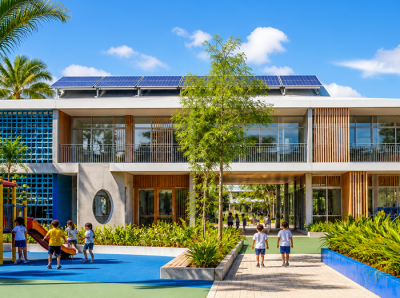
Ghana is continuing to strengthen its public education infrastructure through new school construction, secondary education expansion, school rehabilitation, and investment in teaching and learning resources.
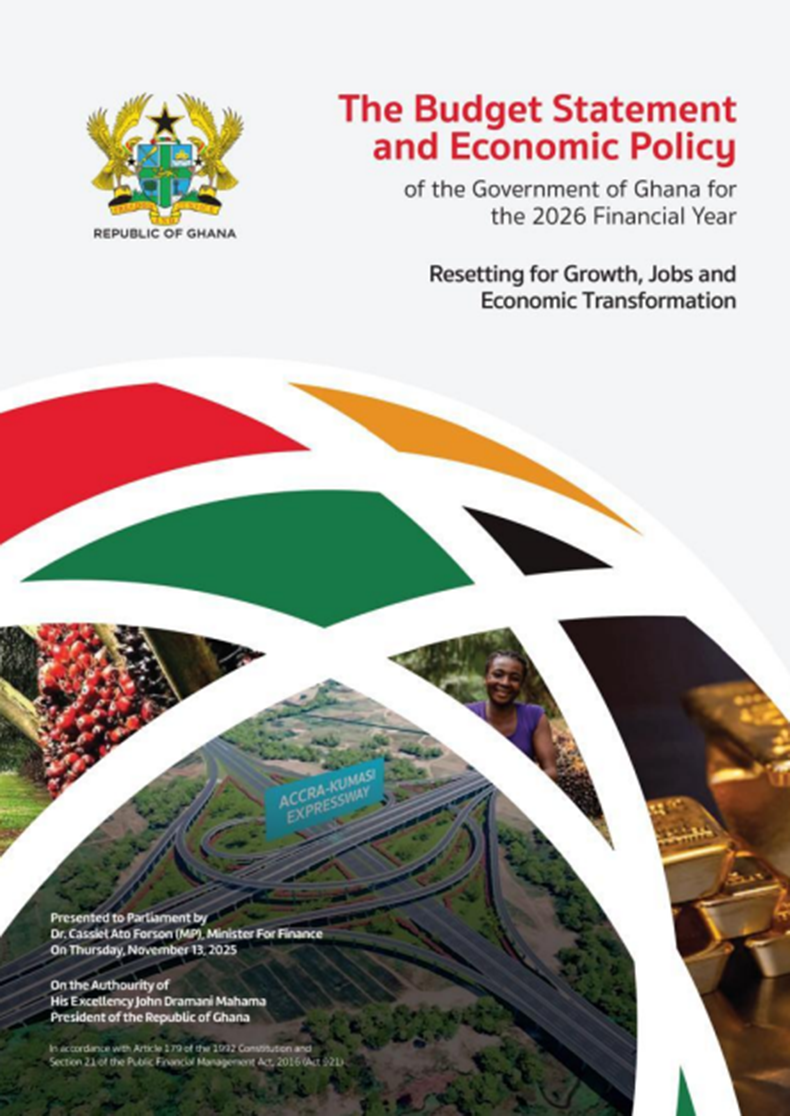
The country's 2026 Budget Statement and Economic Policy sets out a major infrastructure program for underserved communities, including the construction of 200 new Junior High Schools (JHS), 200 new primary schools, and 200 kindergartens. The government has allocated GH¢2.0 billion for these construction projects, together with 400 four-unit teachers' bungalows and 400 sanitation facilities. The government also states that the new schools will come with furnishing and are expected to provide access to more than 200,000 additional students annually.
At the same time, Ghana has allocated GH¢3.0 billion for a package of teaching and learning resources, including the procurement of more than 2 million metal mono-desks and chairs for secondary schools and selected district education directorates.
Ghana Plans 600 New Basic Education Facilities
One of the most significant elements of Ghana's 2026 education investment is the expansion of basic education infrastructure.
According to the official 2026 Budget Statement, the Ghana Education Trust Fund (GETFund) will support the construction of:
• 200 new Junior High Schools
• 200 new primary schools
• 200 kindergartens
• 400 four-unit teachers' bungalows
• 400 sanitation facilities
The projects are targeted at underserved communities, where additional education infrastructure is needed to improve access and reduce pressure on existing schools.
The government has allocated GH¢2.0 billion for this construction program. Importantly for the education furniture industry, the budget explicitly states that each of these new facilities will come with furnishing. The government expects the program to provide access to more than 200,000 additional students every year.
This makes the program particularly relevant to school furniture manufacturers because the construction of new schools can generate demand across multiple categories, including student desks and chairs, teacher furniture, kindergarten furniture, storage cabinets, and other classroom products.
Official Source: Ministry of Finance, Republic of Ghana
2026 Budget Statement and Economic Policy — Ghana Ministry of Finance
More Than 2 Million Metal Mono-Desks and Chairs to Be Procured
Ghana's education investment is also directly connected to school furniture procurement.
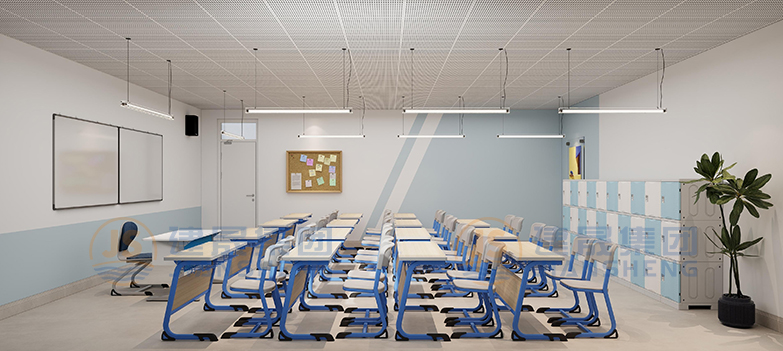
The 2026 Budget states that the government will allocate GH¢3.0 billion for a package covering textbooks, learning resources, and other educational materials. Within this allocation, the government plans to procure more than 2 million pieces of metal mono-desks and chairs for secondary schools across the country and selected district education directorates.
This is one of the clearest indicators of large-scale school furniture demand in Ghana's current education market.
Metal mono-desks are widely used in classrooms and are particularly suitable for large public-school projects because they can provide a practical combination of durability, standardized production, and ease of deployment.
For international school furniture suppliers, the procurement program highlights several potential product categories:
• Metal student desks and chairs
• Classroom chairs
• Teacher desks and chairs
• Kindergarten furniture
• School storage cabinets
• Laboratory furniture
• Library furniture
The scale of the planned procurement also highlights the importance of production capacity, consistent quality, packaging, logistics, and project delivery when supplying large government education programs.
Secondary Education Infrastructure Is Also Being Upgraded
Ghana's education infrastructure strategy extends beyond primary schools and kindergartens.
The 2026 Budget includes a series of measures designed to improve secondary education infrastructure and address the capacity pressures created by the expansion of Free Senior High School education.
The government plans to:
• Upgrade Category A schools with new classroom blocks, dormitories, and quality improvements.
• Upgrade 10 Category B schools to Category A.
• Upgrade another 30 Category C schools to Category B, including new classrooms, modern science resource centres, digital learning centres, and water and sanitation systems.
• Complete 30 abandoned E-Blocks, or Community Day Senior High Schools, in urban and peri-urban areas.
• Expand access in regions where demand for secondary education is high.
These projects could create demand for a wider range of educational furniture beyond standard student desks.
As secondary schools develop more specialized spaces, potential requirements can include classroom furniture, dormitory furniture, library furniture, laboratory tables, computer classroom furniture, teacher furniture, and storage solutions.
STARR-J Project to Strengthen Secondary Education Infrastructure
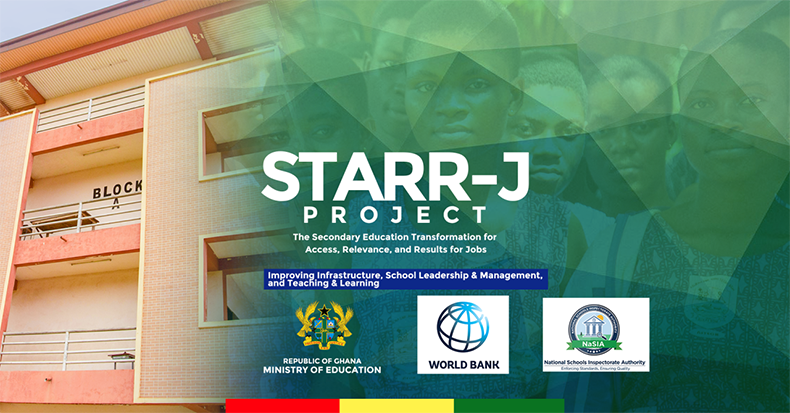
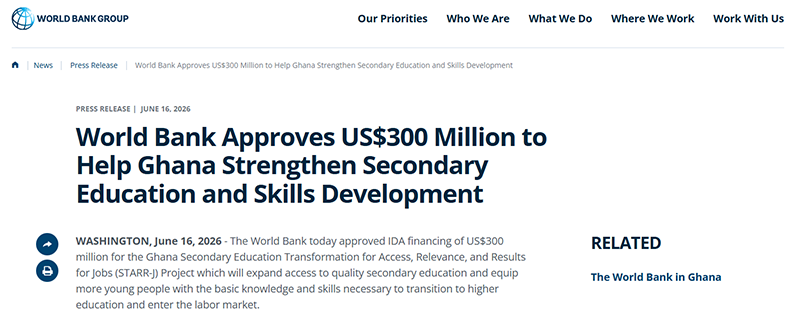
Ghana is also advancing the Secondary Education Transformation for Access, Relevance, and Results for Jobs (STARR-J) project, supported by the World Bank. The project aims to expand access to quality secondary education, improve learning outcomes, and strengthen STEM and TVET education.
In June 2026, the World Bank approved US$300 million in financing for the project, which is expected to support approximately 2.2 million students across nearly 1,000 public secondary schools, particularly in underserved rural and peri-urban communities. The program includes school rehabilitation, upgrades, and new infrastructure.
According to NaSIA, STARR-J will run from 2026 to 2030, creating demand for modern learning environments and potentially increasing opportunities for classroom furniture, laboratory furniture, STEM workstations, and other educational space solutions.
Official Sources:
STARR-J Project — NaSIA Official Information
World Bank — US$300 Million STARR-J Project for Ghana
School Infrastructure Development Is Extending to Local Communities
Ghana's education infrastructure development is also visible at the local government level.
In July 2026, Ghana's Information Services Department reported that the Kumbungu District had completed or handed over several classroom projects and was continuing other school rehabilitation projects.
To address furniture shortages in the district, 1,200 dual desks and 320 teacher tables and chairs had been supplied. GETFund-supported projects at Kumbungu Senior High School, including a dormitory, dining hall, and assembly hall, were also progressing.
This example demonstrates that school furniture demand in Ghana is not limited to national-level procurement. Local education infrastructure projects can also create opportunities for:
• Student desks and chairs
• Teacher tables and chairs
• Dormitory furniture
• Dining hall furniture
• Classroom storage
• Other school facility furniture
For international manufacturers, this suggests that both central government programs and local education projects may be worth tracking.
What Types of School Furniture Could Be Needed?
New and upgraded education facilities typically require a broad range of furniture beyond standard student desks and chairs, including:
Student Desks and Chairs – Durable classroom furniture for primary, JHS, and secondary students.
Kindergarten Furniture – Child-sized tables, chairs, storage units, and activity furniture.
Teacher Furniture – Teacher desks, chairs, and storage solutions for classrooms and staff areas.
Steel Storage Cabinets – Durable storage for classrooms, offices, libraries, and laboratories.
Laboratory and Specialized Classroom Furniture – Workstations, laboratory tables, computer classroom furniture, and storage solutions.
For large-scale government education projects, suppliers with a complete school furniture portfolio can provide more consistent and efficient project support.
What Do School Furniture Projects Need to Consider?
For large-scale school furniture projects, procurement teams typically consider more than unit price. Key factors include:
Production Capacity – Stable manufacturing capacity and consistent quality are essential for large-volume orders.
Durability and Safety – Furniture should withstand intensive daily use while providing a safe and ergonomic learning environment.
KD Design and Shipping Efficiency – Knock-down furniture can reduce shipping volume, improve container utilization, and help optimize international logistics costs.
Complete Solutions and Project Support – A broad product portfolio and reliable project support can simplify procurement for new schools and education infrastructure projects.
These factors are especially important for government-funded projects involving large quantities and multiple school locations.
Opportunities for International School Furniture Suppliers in Ghana
Ghana's current education investment combines new school construction, school expansion, infrastructure rehabilitation, furniture procurement, and secondary education development.
For international school furniture manufacturers and suppliers, several areas are worth monitoring:
• New primary school construction
• Junior High School projects
• Kindergarten construction
• Secondary school infrastructure projects
• E-Block projects
• School rehabilitation and expansion
• Public school furniture tenders
• GETFund-supported projects
• STEM and laboratory facilities
• School furniture distributors and importers
• Education and construction project contractors
The combination of 600 new basic education facilities and more than 2 million planned metal mono-desks and chairs makes classroom furniture one of the most directly relevant product categories in Ghana's current education investment plan.
At the same time, secondary education infrastructure programs such as STARR-J are creating opportunities for more specialized furniture and complete educational space solutions.
Jiansheng Group: Supporting Global Education Furniture Projects
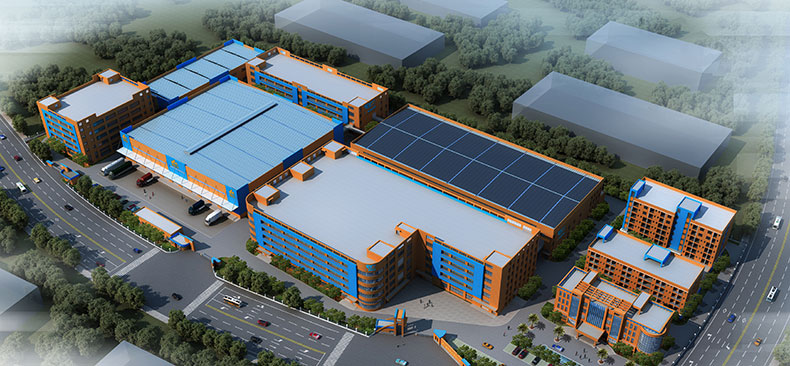
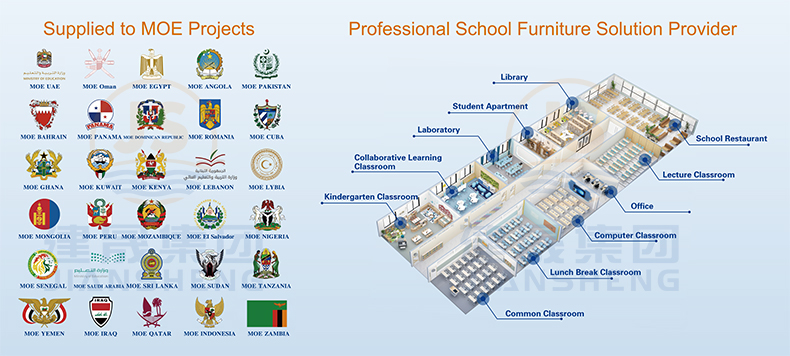
With more than 23 years of experience, Jiansheng Group specializes in school furniture R&D and manufacturing. With a 150,000㎡ manufacturing base, we have supplied school furniture to 132 countries and regions and 40+ MOE projects. As an experienced MOE Tender Expert, we provide complete school furniture solutions for education projects worldwide.
Our product portfolio includes student desks and chairs, kindergarten furniture, teacher furniture, classroom furniture, steel cabinets, dormitory furniture, and laboratory furniture, with OEM & ODM, custom colors, custom logos, and 3D design services available for different project requirements.
As Ghana continues to expand its education infrastructure, Jiansheng Group is ready to support schools, distributors, contractors, and government education projects with reliable, large-scale school furniture solutions.
Official Sources
1. Ghana Ministry of Finance — 2026 Budget Statement and Economic Policy
Ghana 2026 Budget Statement and Economic Policy — Official PDF
2. Ghana Ministry of Finance — 2026 Budget Speech
Ghana 2026 Budget Speech — Official PDF
3. Ghana Ministry of Finance — 2026 National Budget
2026 Budget Statement — Ghana Ministry of Finance
4. National Schools Inspectorate Authority (NaSIA) — STARR-J Project
STARR-J Project — NaSIA Official Page
5. World Bank — Ghana STARR-J Project
World Bank — US$300 Million for Ghana's STARR-J Project
6. Ghana Information Services Department — Kumbungu Education Infrastructure
Kumbungu Education Infrastructure and Furniture Update — Ghana ISD